

(EN: Woven Space – The Evolution of Monumental Liturgical Textiles and Their Role in Shaping the Altar Area (4th–16th c.)
Laufzeit: seit 2026
Projektleitung: Dr. Julia Matveyeva
Projektbeschreibung:
Liturgische Textilien gehörten zu den bedeutendsten, zugleich aber am wenigsten verstandenen Elementen des christlichen Altarraums. Im Konstantinopel des 6. Jahrhunderts erschienen sie als monumentale Vorhänge mit großformatigen Bildprogrammen. Während der Liturgie konnten diese Textilien geöffnet und geschlossen werden. Dadurch entstand eine bewegliche Grenze zwischen sakralen und profanen Bereichen, die den liturgischen Raum dynamisch strukturierte und aktiv in das rituelle Geschehen eingriff. Zugleich machten ihre Bildprogramme die theologische Bedeutung der am Altar vollzogenen liturgischen Handlungen sichtbar.
Trotz ihrer großen Bedeutung sind aus der Zeit vor dem 11. Jahrhundert fast keine liturgischen Textilien erhalten geblieben. Ein wesentlicher Teil der mittelalterlichen sakralen Kultur ist daher heute nur schwer zugänglich. Zwar liefern schriftliche und bildliche Quellen zahlreiche Hinweise, doch hat terminologische Unklarheit lange verhindert, dieses Material systematisch auszuwerten. Begriffe wie katapetasma, aer, epitaphios, velum oder parapetasma wurden nicht einheitlich verwendet: Mitunter bezeichneten verschiedene Begriffe dasselbe Objekt, in anderen Fällen veränderte sich die Bedeutung eines Begriffs im Laufe der Zeit. Diese terminologische Unschärfe in den Textquellen erschwert es, genau zu bestimmen, welche konkreten Textilobjekte in den schriftlichen Quellen beschrieben, in Bildwerken dargestellt oder in späteren Museumssammlungen überliefert sind. Viele erhaltene Objekte werden daher bis heute nur vorläufig identifiziert, während ihre ursprünglichen liturgischen Funktionen unklar bleiben.
Das Forschungsprojekt untersucht die Entwicklung monumentaler liturgischer Textilien im christlichen Altarraum vom 4. bis zum frühen 16. Jahrhundert in östlichen und westlichen Traditionen. Ziel ist es, ein diachrones Modell der Entwicklung ihrer Formen, Funktionen und symbolischen Bedeutungen zu erarbeiten und ihre Rolle als raumbildende, theologisch aufgeladene und symbolisch bedeutungsvolle Elemente der sakralen Architektur neu zu bewerten.
Die Studie verbindet terminologische, funktionale, ikonographische und architektonische Perspektiven in einer Synthese, die in der Forschung zu liturgischen Textilien bisher noch nicht unternommen wurde. Dadurch eröffnet sie ein Forschungsfeld, das lange übersehen wurde, für das Verständnis der mittelalterlichen sakralen Kultur jedoch zentral ist – an der Schnittstelle von Textilgeschichte, Kunstgeschichte, Architekturgeschichte und Liturgiewissenschaft.
Fünf zentrale Fragen strukturieren das Projekt:
1. Terminologie und Semantik – Wie entwickelten sich Begriffe wie katapetasma, aer, epitaphios, velum oder parapetasma, und welche Bedeutungsverschiebungen lassen sich in schriftlichen Quellen beobachten?
2. Formen und Funktionen – Welche liturgischen und theologischen Faktoren prägten Formate, Materialien und ikonographische Programme monumentaler Textilien?
3. Ost–West-Beziehungen – Lassen sich Prozesse des Transfers zwischen byzantinischen und lateinischen Traditionen erkennen, und wo zeigen sich Konvergenzen oder Divergenzen?
4. Architektur und Raumwirkung – In welchem Maß beeinflussten Textilien die Entstehung und Transformation architektonischer Elemente wie Ziborium, Templon, Ikonostase oder Chorschranken?
5. Rekonstruktion verlorener Formen – Wie lassen sich Textilobjekte aus Epochen ohne erhaltene materielle Zeugnisse auf der Grundlage schriftlicher und bildlicher Quellen plausibel rekonstruieren?
Die Methodik verbindet drei Kategorien von Quellen:
– schriftliche Quellen in griechischer und lateinischer Sprache
– bildliche Quellen (Mosaiken, Wandmalerei, Buchmalerei, Reliefs)
– erhaltene Textilien in internationalen Museumssammlungen
Alle Belege werden in einer chronologischen Forschungsdatenbank zusammengeführt, die schriftliche Dokumentation mit ikonographischen Monumenten und materiellen Objekten verknüpft. Diese Datenbank dient als Vergleichsinstrument für Zuschreibungen, Analysen und historische Rekonstruktionen und kann sich später zu einer offenen digitalen Plattform entwickeln, die der internationalen Forschungsgemeinschaft zugänglich ist.
Das Projekt gliedert sich in drei Arbeitsphasen:
1. Aufbau einer farbcodierten Forschungsdatenbank
2. Entwicklung eines diachronen analytischen Modells
3. Ausarbeitung einer wissenschaftlichen Monographie
Interdisziplinär angelegt, verbindet das Projekt westliche, byzantinische und ostslawische Forschungstraditionen und schlägt ein neues Referenzmodell für die Untersuchung liturgischer Textilien vor. Seine Ergebnisse werden nicht nur zur christlichen Archäologie und zur Geschichte sakraler Architektur beitragen, sondern auch zu breiteren Diskussionen über das Zusammenspiel von Kunst, materieller Kultur, Ritual und Theologie im europäischen und mediterranen Raum.
In dieser Perspektive erscheinen liturgische Textilien nicht mehr nur als dekorative Elemente, sondern als wirkungsvolle Medien, die sakrale Räume formten und theologische Bedeutungen innerhalb der christlichen Liturgie sichtbar machten.
Woven Space: The Evolution of Monumental Liturgical Textiles and Their Role in Shaping the Altar Area (4th–16th c.)
Liturgical textiles were among the most significant yet least understood elements of the Christian altar area. In sixth-century Constantinople they appeared as monumental curtains with large-scale iconographic programs. These textiles could be opened and closed during the liturgy, creating a dynamic boundary between sacred and profane zones and actively participating in ritual action. Through their imagery they also revealed the theological meaning of the mysteries enacted at the altar.
Despite their importance, almost no liturgical textiles survive from before the eleventh century. As a result, this dimension of medieval sacred culture remains largely inaccessible. Although textual and visual sources provide abundant evidence, terminological confusion has long prevented scholars from using this material systematically. Terms such as katapetasma, aer, epitaphios, velum, or parapetasma were used inconsistently: in some cases different terms referred to the same object, while in others the meaning of a term changed over time. This terminological ambiguity in textual sources makes it difficult to determine which specific textile objects are described in written evidence, represented in visual sources, or preserved in later museum collections, where surviving objects are often identified only provisionally and their original liturgical functions remain uncertain.
This research project examines the development of large-scale liturgical textiles in the Christian altar area from the fourth to the early sixteenth century in both Eastern and Western traditions. Its aim is to construct a diachronic model of the evolution of their forms, functions, and symbolic meanings and to reassess their role as spatially formative, theologically charged, and symbolically significant elements of sacred architecture.
The study brings together terminological, functional, iconographic, and architectural approaches in a synthesis not previously attempted in the field of liturgical textile studies. By doing so, it opens a field of inquiry that has long been overlooked but is essential for understanding medieval sacred culture at the intersection of textile history, art history, architectural history, and liturgical studies.
Five core questions guide the project:
- Terminology and semantics – How did terms such as katapetasma, aer, epitaphios, velum, or parapetasma evolve, and what semantic shifts can be traced in textual sources?
- Forms and functions – What liturgical and theological factors shaped the formats, materials, and iconographic programs of monumental textiles?
- East–West relations – Can processes of transfer between Byzantine and Latin traditions be identified, and where did convergence or divergence occur?
- Architecture and spatial impact – To what extent did textiles influence the emergence and transformation of architectural elements such as the ciborium, templon, iconostasis, and choir screens?
- Reconstruction of lost forms – How can textile objects from periods without surviving material evidence be plausibly reconstructed on the basis of textual and visual sources?
The methodology combines three categories of evidence:
– textual sources in Greek and Latin
– visual sources (mosaics, wall paintings, manuscript illumination, reliefs)
– surviving textile objects preserved in international collections
All evidence will be organized in a chronological research database that links textual documentation with iconographic monuments and material objects. This database will serve as a comparative tool for attribution, analysis, and historical reconstruction and may later develop into an open digital platform accessible to the international scholarly community.
The project unfolds in three phases:
- the creation of a color-coded research database,
- the development of a diachronic analytical model,
- the preparation of a scholarly monograph.
Interdisciplinary in scope, the project integrates Western, Byzantine, and East Slavic research traditions and proposes a new reference model for the study of liturgical textiles. Its results will contribute not only to Christian archaeology and the history of sacred architecture, but also to broader discussions of the interaction between art, material culture, ritual, and theology in the European and Mediterranean worlds.
In this perspective, liturgical textiles appear not merely as decorative elements, but as powerful mediators that shaped sacred space and articulated theological meaning within the Christian liturgy.
Bild oben auf der Seite:
Vorhang vor dem Eingang zum Tempel der Fortuna. Detail des sogenannten „Nilmosaiks“, ca. 1. Jh. v. Chr., Palestrina, Italien. (Image at the top of the page: Curtain before the entrance to the Temple of Fortuna. Detail of the so-called “Nile Mosaic”, ca. 1st century BC, Palestrina, Italy.)
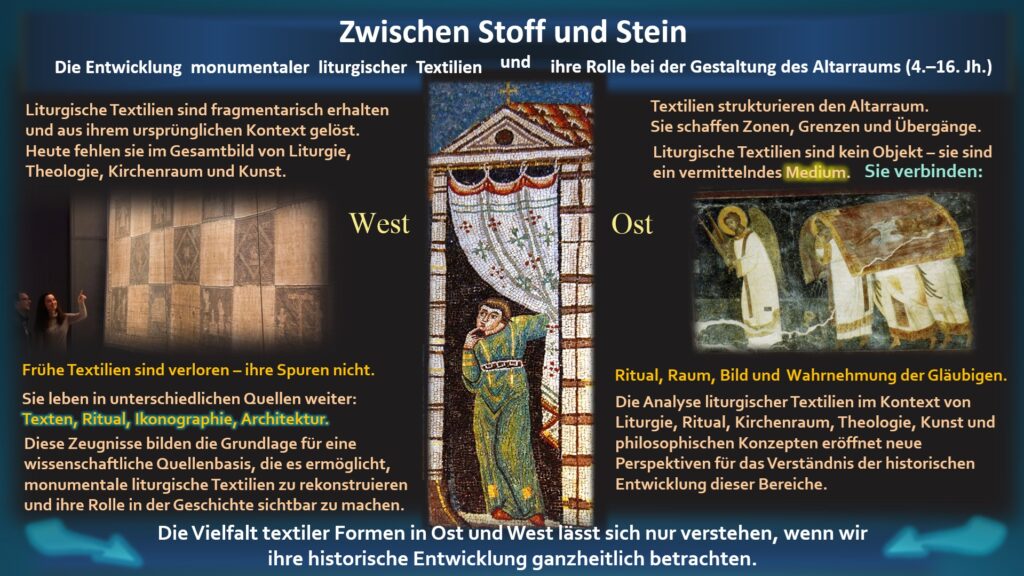
Visuelle Konzeptdarstellung des Projekts „Zwischen Stoff und Stein“
Visual conceptual representation of the project „Zwischen Stoff und Stein“.
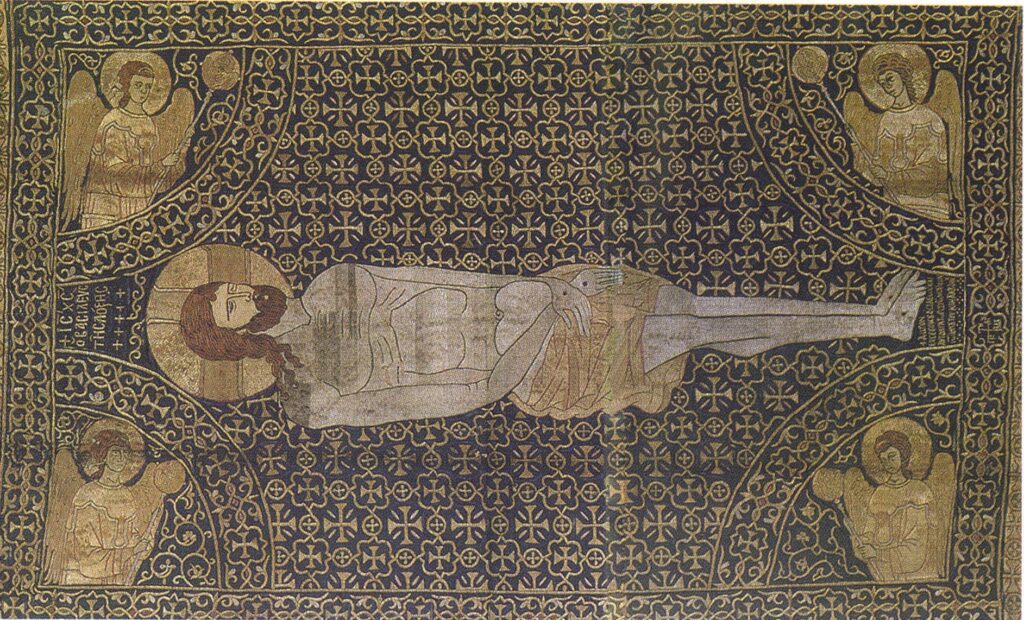
Christus im Grab und Engel. Aer, 1354, Byzanz. Stiftung des Kaisers Johannes Kantakuzenos. Kloster Vatopedi, Athos (Griechenland).
Christ in the Tomb and Angels. Aer, 1354, Byzantium. Donated by Emperor John VI Kantakouzenos. Monastery of Vatopedi, Mount Athos (Greece).
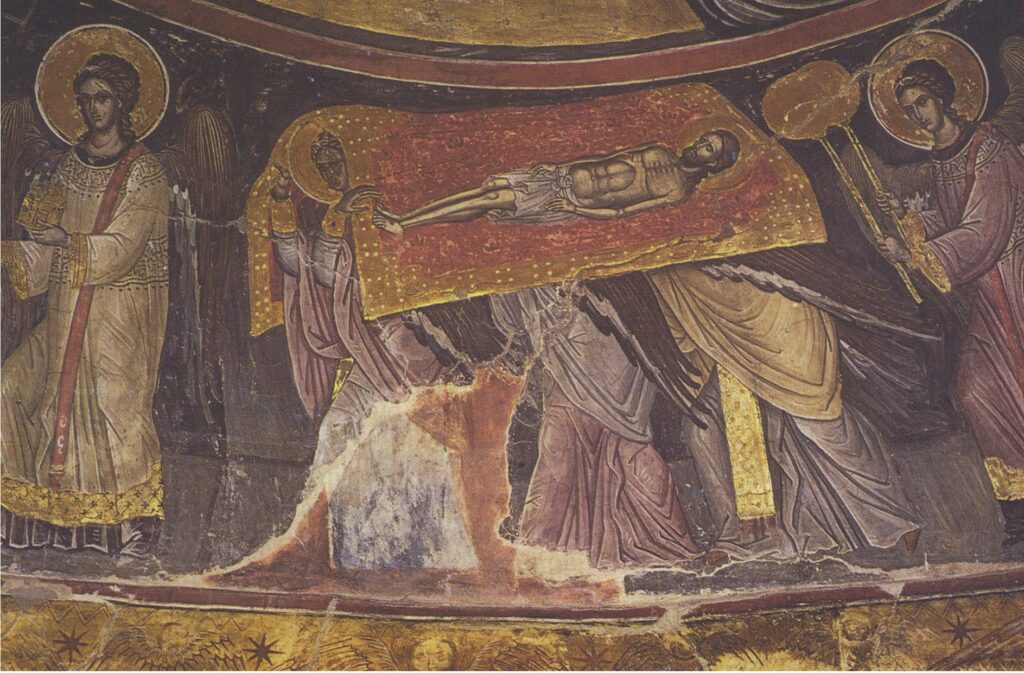
Himmlische Liturgie. Fresko, 15.–16. Jh., Kloster Stavronikita, Athos (Griechenland).
Heavenly Liturgy. Fresco, 15th–16th century, Monastery of Stavronikita, Mount Athos (Greece).
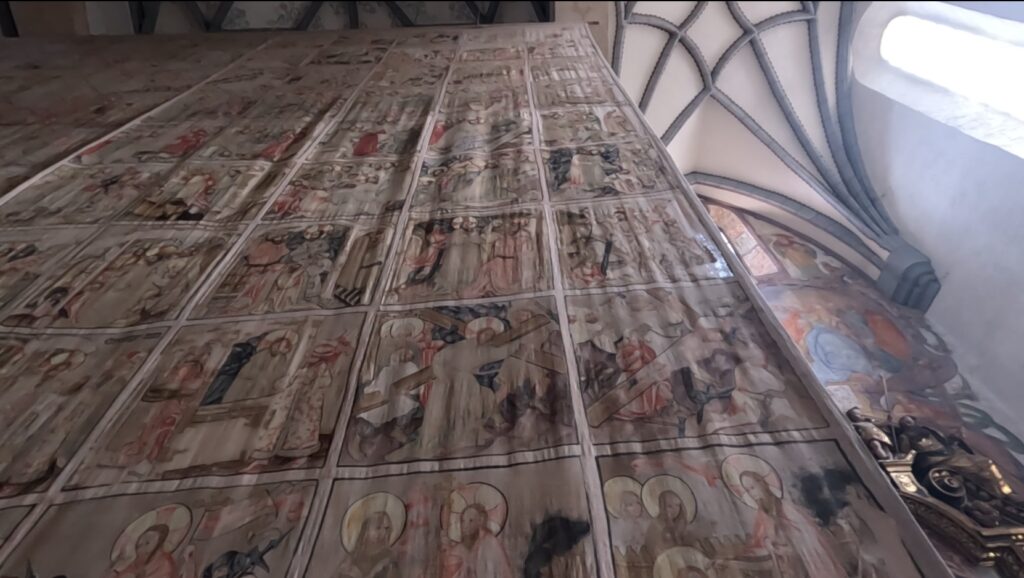
Fastentuch des Doms zu Gurk. Ansicht im Altarraum (rechte Seite). 1458. Ca. 900 × 900 cm. 99 Szenen aus der Heiligen Schrift; Komposition von oben nach unten und von links nach rechts gelesen, mit der Auferstehung unten rechts. Österreich.
Lenten Veil of Gurk Cathedral. View in the altar area (right side). 1458. Approx. 900 × 900 cm. 99 scenes from the Holy Scripture; composition read from top to bottom and from left to right, ending with the Resurrection at the lower right. Austria.
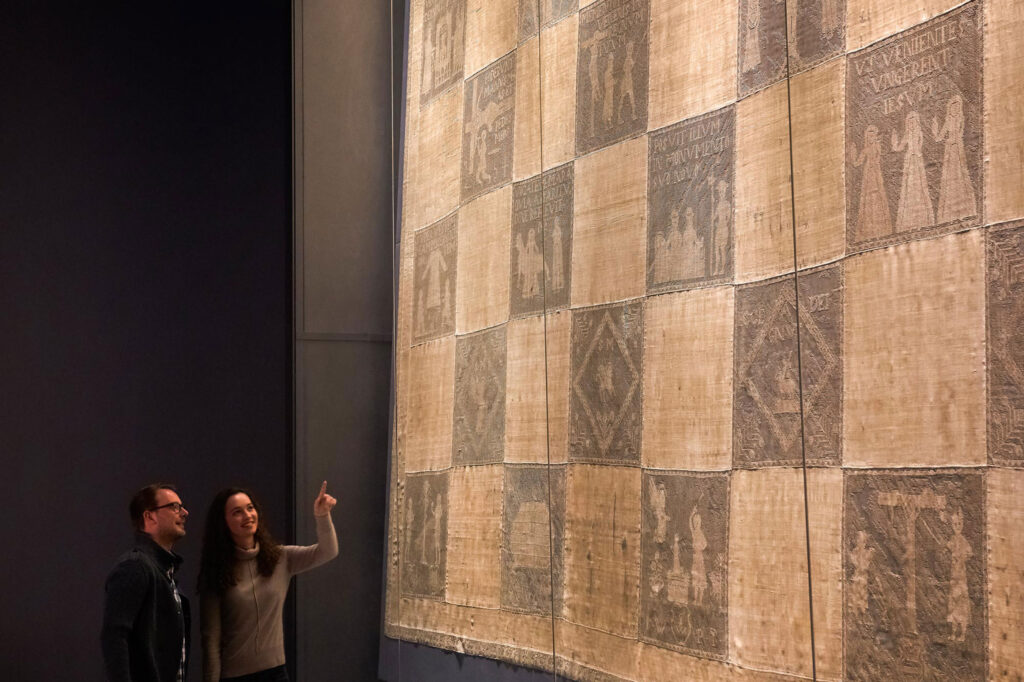
Telgter Hungertuch aus der Kirche St. Clemens, 1623, Telgte (Deutschland). Heute im RELíGIO – Westfälisches Museum für religiöse Kultur. 33 Bildfelder in Filetspitze sind mit 33 Leinenquadraten verbunden.
Telgte Lenten Veil from the Church of St. Clemens, 1623, Telgte (Germany). Now in the RELíGIO – Westphalian Museum of Religious Culture. 33 figural panels in filet lace are combined with 33 linen squares.